.jpg)


















Africa: Why Has France Returned to Chad at All Costs
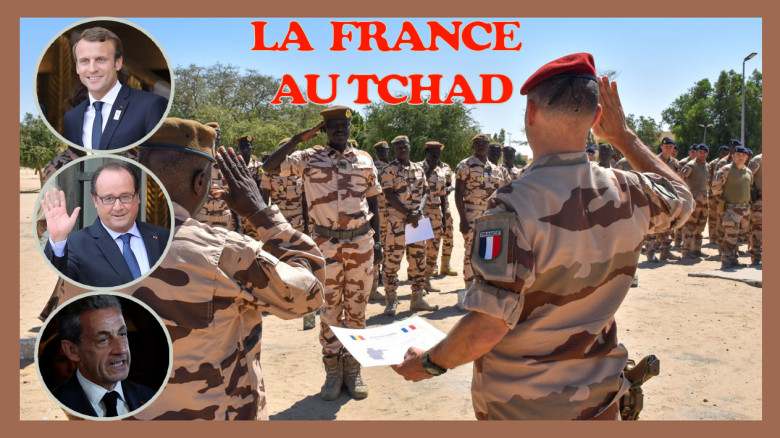
By: Joe Le Mutant – Charilogone Editorial TeamFor decades, the relationship between France and Chad has raised many questions. For some observers, this persistent presence is not merely the result of traditional cooperation, but of a set of deeply rooted historical, military, geostrategic, and economic interests. Chad, because of its central position in Africa and its regional security role, occupies a unique place in France’s strategic vision. This analysis outlines the reasons often cited to explain why France insists, at all costs, on maintaining its influence in Chad.
The first reason is historical. Chad is not an ordinary country in France’s military strategy: Chadian troops have long been integrated into Paris’s operational systems. Thanks to Chad, some argue that France enjoys a strategic advantage that allows it to carry more weight at the UN Security Council. The vastness of the territory — 1,284,000 km² — and its central location on the continent offer France an ideal platform to monitor the Maghreb, the French‑speaking countries of West Africa, the Sahel‑Saharan belt, and even as far as Djibouti and Sudan. Since independence, under Ngarta Tombalbaye, French spy planes have collected intelligence there on terrorist and jihadist movements, information later shared with international bodies.
In return, France provides several security guarantees: protection of Chadian airports, radar surveillance, geostationary satellite support, and strategic control from Doyaba in the heart of Africa, considered a stable point from which to observe southern Africa all the way to South Africa. Added to this is constant financial and diplomatic support. Paris acts as a guarantor with the Bretton Woods institutions — the World Bank and the IMF — as well as with the Paris Club, the London Club, and the European Union. According to some, this support aims to stabilize fragile public finances since the rise to power of leaders from the BET region, from Goukouni to Mahamat Déby. France is also said to have played a role in several sensitive cases, including slowing down certain complaints filed against Déby father and son at the ICC, or assisting Chad in its legal dispute with Savannah and Glencore.
On the energy front, since the exploitation of the Komé oil fields in Doba, the French military is believed to benefit from privileged access to kerosene, gasoline, and gas needed for its aircraft, tanks, and vehicles. Some even claim that Chadian gas is shipped to France during winter. The French military presence in Chad would thus operate without real oversight, as if on conquered territory. Moreover, each French military intervention in support of successive BET‑origin regimes is said to have been billed as a debt owed to France, a practice allegedly ongoing for 65 years.
France has supported — and according to some, continues to support — a minority in power for 46 years, particularly the heirs of the FROLINAT. Today, it is accused of arming certain groups, such as the Zaghawa Toroboro, to reignite a new war in Darfur against the RSF, in order to influence the situation in the east of the country, especially around Al‑Fasher and in the refugee camps. For these observers, France plays a shadowy, behind‑the‑scenes role in Chadian affairs. Barely back in the country, it reportedly advocated at the United Nations for Chad’s involvement in the Haiti intervention. The successive FROLINAT‑origin governments supported by Paris are said to have brought only death and devastation, and the Chadian people are called upon to awaken and reclaim a power confiscated for far too long.
Indeed, one day, France will have to answer for what some describe as irresponsible actions in Chad. Chadian populations are no longer fooled and aspire to a new political era.
France Bara, Chad Hourra Hourra!!!
By: Joe Le Mutant – The #Charilogone Editorial Team

.gif)


Leave A Comment