



















The French Military Presence in Chad: A Long, Complex, and Always Controversial History
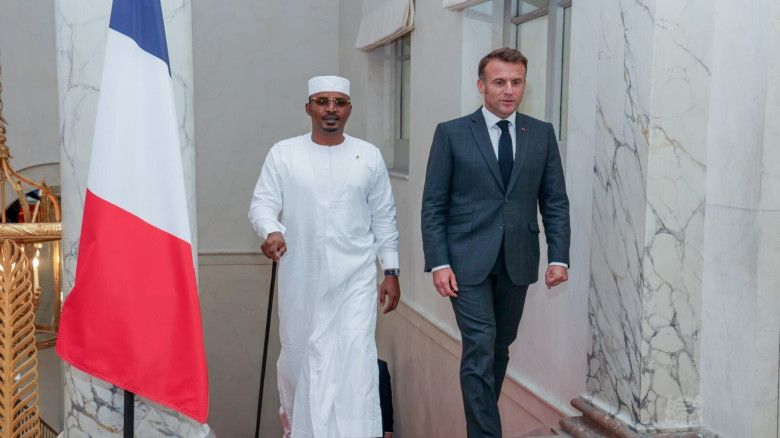
Image: French President Emmanuel Macron, accompanied by the President of Chad, Marshal Mahamat Idriss Déby Itno, during a visit to Paris.By: Joe Le Mutant – Charilogone Editorial Team
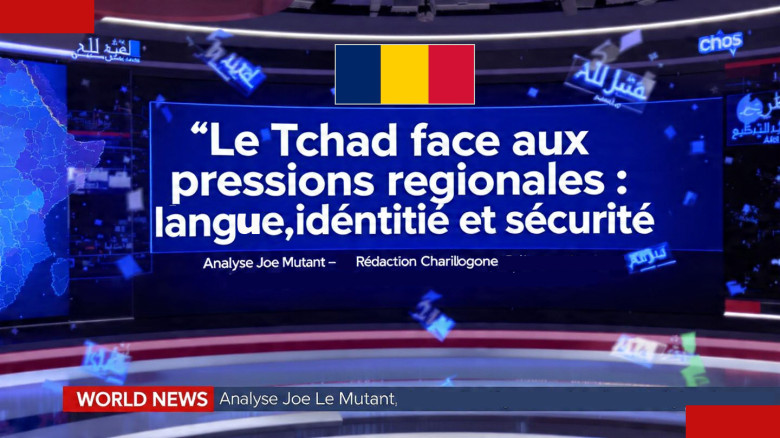
For more than a century, the relationship between Chad and France has been marked by continuous military presence, shifting alliances, and repeated political crises. From colonial conquest to the post‑independence period, through civil wars and current transitions, France has often played a decisive role in the evolution of Chadian power.
Today, the return of French troops raises profound questions: what is the real nature of this presence, whose interests does it serve, and why does it generate so much mistrust among the Chadian public?
A Heavy History: From Colonization to Independence
The French presence in Chad dates back to the late 19th century. After mobilizing Sara workers for the construction of the Congo‑Ocean railway, France established lasting control in the region. In 1900, the death of Rabah marked the consolidation of its military and administrative control.
During World War I (1916‑1919) and World War II (1939‑1945), France recruited large numbers of Chadians—especially Saras—to fight in its ranks. Many veterans even retained French nationality.
At independence in 1960, several Chadian officers trained in the French army—Generals Malloum Ngakoutou, Djibril Nguité Djogo, Odingar, Doumro, etc.—were “loaned” to the new Chadian state to form the backbone of its armed forces.
Political Ruptures and French Interventions
President Ngarta Tombalbaye openly criticized French policy in Chad and attacked Jacques Foccart with “Do pélé au coup pélé.” He was overthrown and assassinated on April 13, 1975.
Malloum Expels the French Army
General Malloum demanded the departure of French troops. In response, Paris supported rebel factions of the FROLINAT—first Goukouni Weddeye, then Hissène Habré. This led to the civil war of February 12, 1979.
Hissène Habré: The Strategic Ally
Goukouni, considered too close to Libya under Gaddafi, was sidelined in favor of Habré, supported by France. With French military backing, Habré fought Libya in the Aozou Strip and remained in power until 1990.
His downfall came after he considered granting oil exploitation rights in southern Chad to the American company Esso.
At the La Baule summit, he challenged François Mitterrand:
“Who are you to lecture us on democracy?”
Mitterrand replied: “The future will tell.”
Idriss Déby Itno: 31 Years of Ambivalent Relations
Seen as a privileged ally of France, Idriss Déby ruled for 31 years. Toward the end of his reign, he too criticized Paris, declaring “Damboula anakou” in Chadian Arabic during his last campaign. He died on April 19, 2021, under circumstances still debated.
For the first time, a French president—Emmanuel Macron—personally attended his funeral and supported the transition led by Mahamat Idriss Déby Itno.
Mahamat Idriss Déby Itno: Rupture, Return, and Ambiguities
Mahamat Idriss Déby Itno requested the departure of French forces, which returned two years later. This oscillation continues to fuel questions.
Legitimate and Persistent Questions
What real service does the French army provide to Chad through its presence?
Why does every withdrawal request seem to destabilize regimes in power?
Why are defense agreements kept secret and signed without Chadian legal experts?
What legitimacy do current authorities have to commit the country to such accords without a clear legal framework?
Why are economic aspects consistently neglected, leaving Chad dependent on Bretton Woods institutions for 66 years?
Why do the Borkou‑Ennedi‑Tibesti regions, central to power for 46 years, still lack essential infrastructure despite access to public resources?
How could a hundred French soldiers realistically protect a regime facing growing opposition?
Many observers argue that the current government weakens itself through clannish and exclusive governance, widening opposition and fueling chronic instability. France is often accused of maintaining influence by supporting regimes that serve its strategic interests.
A Collective Inability to Ask the Real Questions
Since 1900, Chadians—both North and South—have struggled to clearly confront France on the fundamental issue of its military presence.
Cardinal Richelieu once said that sustaining power rests on three pillars: the army, public finances, and the reputation of the head of state.
Today, Chad’s leadership appears weakened on all three fronts.
In this context, many fear France continues to rely on certain elites or regions—particularly from the BET—to preserve its influence, as it has done in the past.
France’s Military Calculations
It must be said: France’s military establishment sees no better way to maintain influence in Chad than by relying on the Zaghawa ethnic group, present in both Sudan and Chad. For Paris, Chad remains a strategic country—just like Niger, which managed to expel French forces. In France’s view, no other group could better accomplish what it considers its “dirty work” in Chad.
The history of Chad and France is one of alliances, ruptures, and repeated interventions that have profoundly shaped the country’s political trajectory. More than a century after Rabah’s death, the same questions remain:
What is the true nature of the French military presence? Whose interests does it serve? And why do Chadian leaders struggle to define a balanced and transparent relationship with Paris?
Until these questions receive clear answers, suspicion, instability, and political tension will continue to dominate the national debate.
By: Joe Le Mutant – Charilogone Editorial Team
.gif)


Leave A Comment