






















Libya–Egypt–Sudan: A Risky Game of Alliances
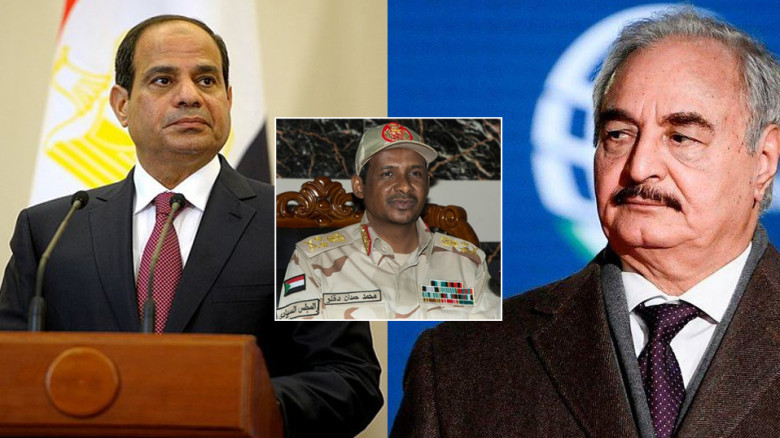
Photo: Egyptian President Abdel Fattah al-Sissi (left), President of the Sudanese Presidential Council of the Peace Government, General Mohamed Hamdan Dagalo, alias Hemeti (center), and Libyan Marshal Khalifa Haftar, commander of the armed forces in eastern Libya (right).By: Charilogone Editorial Team
Egypt has recently issued warnings to Khalifa Haftar, commander of the eastern Libyan forces, over his alleged support for Mohamed Hamdan Dagalo, known as Hemeti, and his Rapid Support Forces (RSF) in Sudan. This situation has created tensions between Cairo and Haftar, as logistical or military backing for the RSF is perceived by Egypt as a direct threat to its national security. Yet, more than 1,000 km separate Egypt from Libya, limiting Cairo’s actual influence over Haftar. Eastern Libya, for its part, does not wish to lose a strategic ally like the RSF, despite Egyptian pressure.
The “national security” argument advanced by Egypt fails to convince many analysts, who see it instead as interference in Sudan’s internal affairs. The RSF has never attacked Egypt nor expressed any intention of doing so; the conflict remains internal to Sudan. For Cairo, the real objective is to keep the Sudanese army in power and block reforms demanded by the RSF and the Tasis coalition. The central question remains: which Sudanese army, often described as dominated by Islamists, is Egypt seeking to preserve?
This choice is considered risky. Egypt and certain Arab countries insist on supporting a Sudanese army largely controlled by Islamists, even as Sudanese society aspires to definitively turn the page on Omar al-Bashir’s regime. Several experts highlight the paradox: Cairo fights the Muslim Brotherhood on its own soil, yet supports General Abdel Fattah al-Burhan and his Islamist allies in Sudan, under the banner of “national security.” This stance contrasts sharply with the global dynamic of combating radical Islamism.
On the Libyan front, Egypt views Haftar as an essential ally to secure its western border and contain Islamist influence. But its leverage remains limited. Economically, reconstruction contracts in eastern Libya have been awarded to Egyptian companies, though under fragile dependence. Politically, Haftar favors his ties with the United Arab Emirates, the region’s leading investors, which significantly reduces Cairo’s room for maneuver.
If Haftar were to abandon his support for the RSF, he would risk losing a strategic ally, particularly against the Tripoli government’s ambition to control the entire country by force. The relationship between Haftar and the RSF dates back to the early 2000s, when the Libyan marshal relied on their constant support to consolidate his power and fight jihadists.
The Dispute Over the United Arab Emirates
A new element has heightened tensions: a disagreement between Haftar and Abdel Fattah al-Sissi regarding the United Arab Emirates. The Egyptian president asked Haftar to end his support for the RSF, suspected of receiving backing from Abu Dhabi. Haftar reportedly refused. Yet Egypt itself maintains close economic ties with the UAE, which holds major investments both in Cairo and in eastern Libya. The Emirati role is therefore unavoidable in the regional balance. This situation illustrates the complexity of alliances and the difficulty for Egypt to impose its choices on Haftar, whose political and military survival is closely tied to Emirati support.
Egypt’s support for Haftar appears to be a pragmatic short-term strategy aimed at preserving regional influence and safeguarding its security interests. But in the long run, this gamble remains uncertain and risky. It could narrow Cairo’s diplomatic options, strain its relations with a Sudan in transition, and destabilize its balance with strategic partners such as the United Arab Emirates.
Charilogone Editorial Team

.gif)


Leave A Comment