















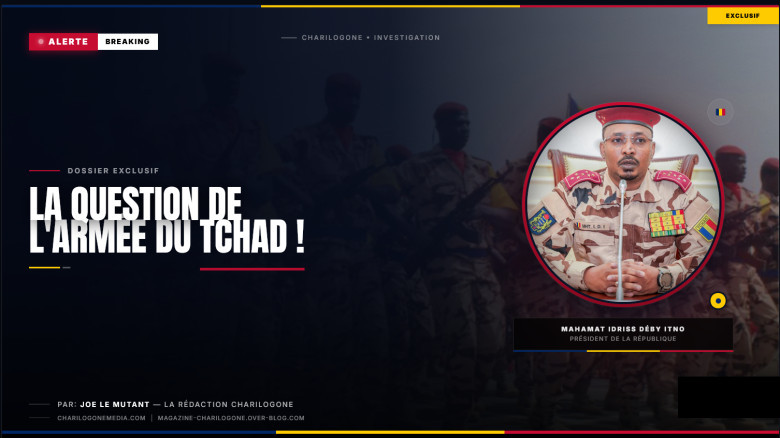
The Question of the Chadian Army
At independence, the ethnic groups that were the majority in the army were generally the Sara (Sara Kaba, Gor, Sar, Mbaye, Hadjaraï, Ngama, Ngambaye, Massa, Mouroum, Gouley, etc.). At the beginning, there were well‑known generals:General Djibril Négué Djogo,
General Malloum, General Odingar,
General Doumro, Maloum Félix Ngakoutou, etc.
Chad strangely finds itself today with 1,600 generals, mostly Zakawa. And among this number, civilians and merchants (including a journalist) have become generals in Chad:
Mahamat Abali Salah, Army Corps General
Seid Protocole, Division General
Ibrahim Terda Kadou, Division General
Beguera Charfadine, Division General
Nassour Noudjiti, Brigade General
Djibert Younouss, Division General
Becher Korom Okora, Division General
Ahmat Oumar Ahmat, Army Corps General
Mahmoud Ali Seid, Division General
Adoum Fortey Amadou, Division General
Ahmed Oumarou Yerima, Brigade General
In 1982, when Hussein Habré took power after Goukouni, he integrated all the rebel fighters of FROLINAT into the army, which was mainly composed of Hadjaraï, Toubou, Gorane and Zakawa, Tama, Arabs and Ouaddaïans. Having little or no education, many ended up as assimilated officers whose ranks were not clearly defined.
Then came Idriss Déby Itno in 1990. The 1993 National Conference demanded a general reform of the army. He understood that a purge was needed, placing mainly his Zakawa relatives who helped him seize power.
Thirty‑one years in power allowed him to establish a clan‑based army, composed mostly of Zakawa, along with Gorane, Toubou, Tama, Boulala and Mayo‑Kébbien, with the help of France and the United States in terms of training and equipment. This assistance lasted from Mitterrand to Chirac, then Sarkozy, Hollande and Macron.
Chad is France’s reserved domain.
Déby senior’s rule was marked by numerous coup attempts and rebellions.
Let us list a few:
Maldom Bada Abbas (Hadjaraï) – Mosanat
Dasser (South) – MPRD
Abbas Koty (Zakawa)
Moïse Ketté (South)
Laoukein Bardé Frisson (South)
Youssouf Togoïmi (Tibesti) – MDJT
Moussa Médéllah (Lake Chad)
Yaya Dilo – SCUD (Iriba)
Mahamat Nour Abdelkérim – FUC
Tom and Timane Erdimi – UFR
Mahamat Nouri – UFDD
Abbas Tollimi – CCMSR / Zakawa
Ali Mahadi (Borkou‑Tibesti) – FACT
Ousmane Dilo (Toroboro) – PSF
The Marshal President Déby had his life and reign saved thanks to two decisive interventions:
The aerial and security coverage of the French army stationed at the Adji Kossey base in Farcha, with its radars and Jaguars, which did not hesitate to bomb our compatriots, causing many deaths and captives among the rebels.
An ethnic turn‑over in the security of the Chadian presidency.
In short, when the attackers were from the North, southern soldiers were used to neutralize them—Hadjaraï against insurgents, or Boulala, and so on.
Except that the Sudanese crisis put the Toroboro in a difficult position in Sudan while they had locked all military command posts in Chad (DGSSIE, DGRI, DGRS, GNNT, ANT, Gendarmerie, Air Force).
To the point that the fall of Al‑Fasher, their fallback base, was easily achieved by Hemeti’s RSF.
Some justify the fall of the Toroboro stronghold as a strategic miscalculation by the Toroboro, who aligned themselves with the Islamist and anti‑Black African regime of Al‑Béchir and later Al‑Burhan.
The Marshal’s son is now at the mercy of the Toroboro in Chad. Clearly, they can overthrow him by abandoning him in the face of a rebellion or by deposing him directly.
It is a matter of strategic interest: supporting their enemy, the RSF in Sudan, would mean annihilating the entire Zakawa ethnic group, which no longer has territory except as refugees in Chad, falling into uncertainty.
Meanwhile, other Chadian ethnic groups excluded from the army could unite to reclaim their place usurped by the Zakawa Toroboro.
Aligning with the Marshal’s son guarantees no position in the Chadian command structure.
During the 2021 political transition, the DNIS clearly demanded a reform of the army for more equitable ethnic representation.
Faced with the Marshal’s refusal to touch his reserved domain, Chad is in a political deadlock.
The dialogue resolutions were bypassed by the extension of the President’s mandate and his appointment as head of the most unpopular party in Chad: the MPS.
We are not yet out of the military rut, with its share of chaos and collateral damage.
This time, it will be the two ethnic blocs that formed FROLINAT who will confront each other: they managed this country for 46 years without developing it, enriching themselves personally instead.
The Gorane versus the Zakawa Toroboro.
The last great war Moussa Faki, former AU President, was likely referring to during his opening speech at the DNIS?
Unless the Quranic verses, cited constantly, are finally understood by the majority of this secular population.
This is the state of the Chadian army.
By: Joe Le Mutant — Charilogone Editorial Team.


.gif)


Leave A Comment