.jpg)





























A New Dawn: Ethiopia’s 7th General Election
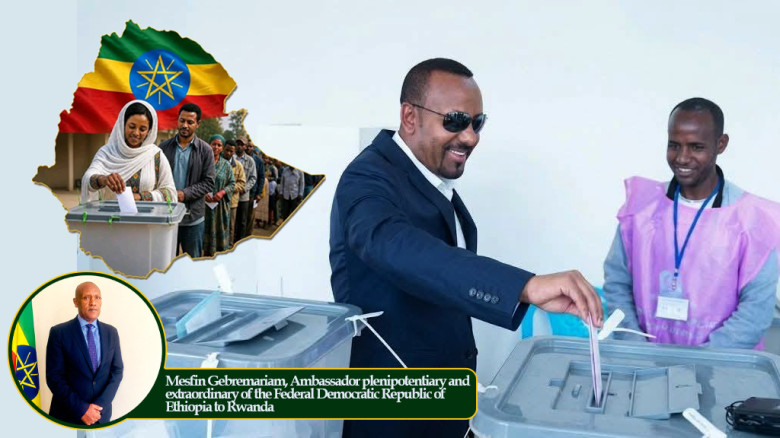
By: Mesfin Gebremariam, Ambassador Plenipotentiary and Extraordinary of the Federal Democratic Republic of Ethiopia to the Republic of Rwanda
A Nation’s Collective Resolve: The Human Spirit at the Ballot Box
The 7th General Election in Ethiopia was not merely a political event; it was a profound manifestation of Ethiopian ultimate determination and a definitive step in the country's journey toward a consolidated democracy. Across the vast landscapes of our nation, from the bustling, vibrant streets of Addis Ababa to the expectant rural constituencies, millions of citizens stood in long, patient queues to cast their ballots. This was a day where the elderly, first-time voters, and persons with disabilities stood side-by-side, united by a common purpose: to shape their own destiny. It was a triumph of civic responsibility over uncertainty, proving that the heart of Ethiopian democracy beats strongly in the chests of its people.
A Record-Breaking Mandate: The Power of 54 Million Voices
The scale of this democratic exercise was historic, reflecting the immense trust the public has placed in the electoral process. More than 54 million citizens registered to vote, a staggering figure that underscores the nationwide commitment to constitutional governance. To accommodate this massive turnout, the National Election Board of Ethiopia (NEBE) operationalized approximately 52,000 polling stations across 501 constituencies. The diversity of choice was equally impressive, with over 10,000 candidates from 42 political parties and 80 independent candidates competing for seats in the House of Peoples' Representatives and regional councils. The sheer logistics—supported by 200,000 staff—demonstrated the government's capacity to host one of the largest and most significant democratic exercises on the African continent.
Modernizing Democracy: An "Election of Many Firsts"
This election cycle was defined by a commitment to modernization and inclusivity, earning it the title of an “Election of Many Firsts”. For the first time, Ethiopia implemented a hybrid registration option, combining web-based self-registration with digital assisted systems to complement traditional manual methods. Efficiency was further enhanced through GIS-based geospatial mapping to organize polling stations, ensuring that the infrastructure of democracy was as precise as it was accessible. Perhaps most significant of all was the introduction of special arrangements for Internally Displaced Persons (IDPs) and members of the National Defense Force, ensuring that no Ethiopian was left behind in this national most defining moment.
Continental Solidarity: The African Union and IGAD’s Seal of Approval
While some sought to cast doubt from afar, our brothers and sisters across Africa stood with us, witnessing the truth on the ground. The African Union (AU) deployed a robust mission of 73 observers from 35 African countries, led by former Kenyan President Uhuru Kenyatta. His assessment was unequivocal: he commended the election for its peaceful, orderly, and transparent conduct, noting that it occurred within a legal framework that truly supports democratic governance. Similarly, the Intergovernmental Authority on Development (IGAD), led by former Ugandan Vice President Speciosa Wandira-Kazibwe, praised the significant electoral reforms and the improved administrative capacity of the NEBE. Their preliminary findings highlighted high voter participation and professional conduct, reinforcing the reality that Ethiopia is setting a regional standard for democratic excellence. The conduct of the General Election was also welcomed by the diplomatic community, which described it as a significant milestone in Ethiopia's democratic journey. This included the European Union's delegation to Ethiopia along with EU member states and the diplomatic missions of Canada, Norway, and Switzerland. While the British Embassy in Addis Ababa congratulated NEBE on the successful conclusion of the voting phase and praised candidates, civil society observers, volunteers, election officials, and citizens for their contributions to the smooth conduct of the vote. Japan also praised Ethiopia for the successful conduct of the election, commending the efforts of electoral authorities and the active participation of citizens in the democratic process.
Rising Above the Noise: Confronting Western Media Narratives Despite the peaceful reality witnessed by millions, a fierce battle over Ethiopia’s international image has been waged by certain Western media outlets and think tanks. These narratives often lean toward "worst-case scenarios" and predictions of instability, ignoring the profound progress made over the last eight years. If observed critically, one can rightly identify that much of this external commentary is a result of unease with Ethiopia’s determination to pursue reforms on its own terms rather than following a prescribed foreign script. By focusing disproportionately on challenges while remaining silent on the massive urban renewal of Addis Ababa and other urban centers, Green Legacy achievements, or the attainment of food security, these outlets fail to capture the lived reality of a country undergoing a rapid and positive socio-economic transformation.
Economic Renaissance: Voting for Growth and Sovereignty The mandate given during this election is also a vote for the Ethiopian Economic Future. Voters recognized the tangible progress of the Grand Ethiopian Renaissance Dam (GERD), which is already generating electricity and powering regional integration. They have seen the sweeping digital reforms in public services and the ambitious infrastructure projects, such as the plans for Africa’s largest international airport. This "investor confidence" is reflected in the continued flow of foreign capital into our markets, as global businesses choose to believe in the reality of our growth rather than the alarmist forecasts of critics. This election was a confirmation that the Ethiopian people want to continue this journey of economic self-reliance and national renewal.
The Road Ahead: Ethiopia’s Unwavering Journey As the ballot counting concludes and the final results are aggregated with transparency and legal rigor, the path forward is clear. Ethiopia is not a country "teetering on the edge," but a nation marching confidently toward its next chapter. The 7th General Election has proven that our democracy, while young, is resilient and deeply rooted in the patriotism of its people. Prime Minister Dr. Abiy Ahmed’s vision of a united and prosperous Ethiopia has been bolstered by the civic responsibility shown by millions. We are a nation that solves its own challenges through democratic processes and peaceful dialogue.
Conclusion: A Triumph for Ethiopia and Africa The 7th General Election was a resounding success that belonged to the people of Ethiopia as it was a day where "Ethiopians have voted, and Ethiopia has won". By rejecting the narratives of division and embracing the responsibility of the vote, our citizens have secured the country’s stability and its future. This is a triumph not just for one nation, but for the entire continent, proving that African-led solutions and African-observed elections can reflect the true will of the people.


.gif)

Leave A Comment