


















Chad: “We shed blood for this power.” Yes — but for what, exactly
The paradox becomes even more brutal when one considers the human price paid, over the decades, by that same community — not only in confrontations with others, but at the hands of the very power it helped bring to office.“We shed blood for this power.” Yes, but for what, exactly?
A phrase repeated for thirty‑five years.
“We shed blood to obtain this power.” Who in Chad has not heard this sentence, brandished by some Zaghawa to justify a hold on power that has now lasted more than thirty‑five years? It refers to a real history. In 1990, fighters from all communities — mostly Zaghawa — took up arms against President Hissène Habré and entered N’Djamena victorious in the name of one precise word: democracy. That sacrifice should never be denied. Chad bears the scars of battles fought by all its communities since the era of Rabah until today, and no tribe holds a monopoly over the blood shed for this country.
But thirty‑five years later, a question must be asked plainly to those who still repeat this phrase like a sacred formula: What have you done with the democracy you claimed to be fighting for? You installed a power that has not nourished those in whose name it was taken.
Fortunately, among the Zaghawa themselves, there are voices that reject this frozen reading of history. Some even took up arms against the very power they helped install. Because the reality is harsh. While a small circle enjoys the country’s wealth, the majority of Zaghawa remain the first victims of the system they helped bring to power. Dar Zaghawa itself, the very region invoked when speaking of “blood shed,” still lives without reliable electricity, without widespread access to clean water, without proper roads, without a university, without a training institute, without an airport — and above all, without peace. Today it is one of the most deprived regions of the country it supposedly helped “liberate.”
The paradox becomes even more cruel when one looks at the human toll paid, over the decades, by this same community — not only facing others, but at the hands of the power it helped install. General Kerim Nassour died defending this power. Yaya Dillo Djérou, cousin of the president and himself a former regime official turned opponent, was killed in February 2024 by security forces during the assault on his party headquarters; his mother and one of his sons had already died three years earlier during a previous attempt to arrest him at his home. Other officials, like Abbas Koty, met equally tragic ends. Zaghawa in exile (such as Bichra Haggar) or dead in exile (such as Hissène Koty) are numerous. Whether defending this power or fighting it, Zaghawa continue to lose their lives. Proof, if any were needed, that aside from a tiny minority, this community has not benefited from the system any more than the other components of the Chadian nation.
So, to those who still brandish the blood shed in the name of democracy: have you seriously measured the disorder that this “democracy” has sown in this country? The same democracy under which fell Ibni Oumar Mahamat Saleh, Yaya Dillo, Abbas Koty, Youssouf Togoïmi, Colonel Moussa Bachar Houno, Dr. Gueti Mahamat, Bichara Digui, Bisso Mamadou, Alhariss Bachar, Sebi Aguid, Adouma Hassaballah, Commander Demtita Ngarbaroum, Colonel Ibrahim Zahab Libiss, Laokein Bardé, Maître Behidi, Moïse Kété… to name only these.
During the early years of MPS rule, hundreds of people were abducted or shot in broad daylight; their crime: owning a vehicle or a motorcycle. In October 1991, hundreds of soldiers and civilians from the same region as the MPS’s number two, Maldoum Bada Abbas, were massacred. In August 1993, around 160 people from the Ouaddaï region were machine‑gunned in the middle of N’Djamena; their crime: daring to organize a protest march against the massacre of 84 people earlier that month in the Ngniguilim market. This is only a glimpse of the crimes committed by the MPS movement — seller of democracy, a spoiled product that served only to destroy the country.
This democracy under which injustice and corruption took root, while some built villas and acquired property abroad with stolen public resources, while the people continued to live in deprivation.
One might have, at a stretch, overlooked the longevity of the regime and its excesses in the name of peace, security, and development — if, in return, this power had truly built the country, established justice, and fought corruption by relentlessly targeting those who plundered public goods. This tacit bargain, in the absence of another, might have made sense. But it was never honored.
A price paid by a generation that asked for nothing. One must also look at what this system has produced among the youth. Adolescents who now pour out their anger — sometimes unfairly directed at an entire community rather than at the system — are themselves victims of this façade democracy that deprived them of education. These children grew up watching their parents struggle to meet basic needs. Parents sometimes forced into economic exile, leaving their children to face alone a daily life far too heavy for their age. This generation grew up too fast, not by choice, but because the country left them no other option.
It is not too late for a mea culpa. In April 2021, upon the arrival of the Transitional Military Council, Chadians, in their overwhelming majority, pledged allegiance to it. They believed — perhaps naively — that a young leader might finally break with the practices of a system he himself embodied by lineage, by fighting corruption and putting the country back on the path of development. Five years later, that hope has evaporated, swept away by the same wind that has blown over this corrupt system since 1990. The conclusion that emerges is perhaps more accurate than the one we thought we had to make: Chadians are not truly waiting for democracy, but for justice — the foundation upon which everything else can return to its natural order. The Gulf monarchies illustrate this in their own way: without Western‑style democracy, their populations nonetheless enjoy comfort, peace, and a sense of justice sufficient not to demand anything else.
None of this is irreversible. It would be enough to acknowledge, plainly, that the democratic gamble promised in 1990 has failed — not to humiliate anyone, but to allow the country to collectively reset the clock. The only credible path now is justice, nothing but justice, applied to all, without distinction of ethnicity or proximity to power. It is this justice, and only this justice, that will allow all communities in Chad — Zaghawa first among them — to finally live in peace and social cohesion rather than in inter‑community confrontations that waste precious time while other nations move forward.
The blood shed in 1990 deserves better than a formula repeated to justify a status quo that has benefited only a few. It calls for a genuine examination of conscience.
For Marshal Mahamat Idriss Déby, it is a matter of seeing the trees rather than the forest. In other words, taking seriously the mobilization of dozens of adolescents against his policies. It is a strong signal to seize in order to recover quickly — even immediately — and undertake a radical change, proof that hope remains, with or without him.
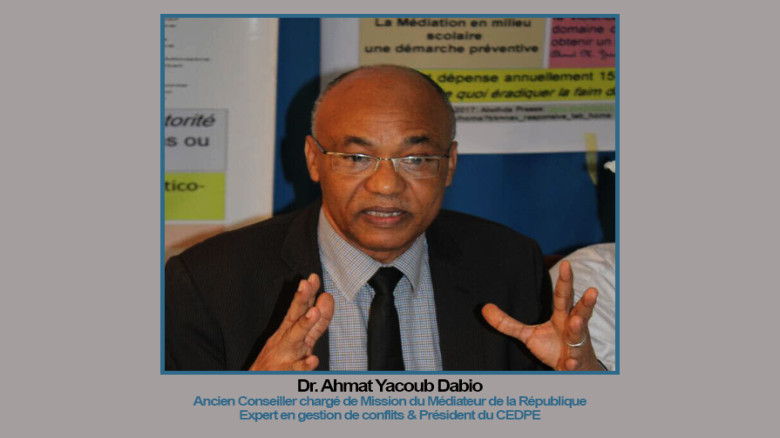
Dr. Ahmat Yacoub Dabio
Former Special Advisor to the Mediator of the Republic
Conflict Management Expert
President of CEDPE



.gif)

Leave A Comment