.jpg)


























Mali: Analysis of the Events in Anefis Between 4 and 9 July 2026
On 4 July 2026, at around 5:30 a.m., a coalition of terrorist groups — Jamaat Nusrat al‑Islam wal‑Muslimin and the Front de libération de l’Azawad — under the command of Iyad Ag Gali and Algabass Ag Intalla, carried out a terrorist attack against the locality of Anefis in the Republic of Mali, as well as against the base of the allied forces of the Africa Corps of the Armed Forces of the Russian Federation and the Malian Army.(Disclaimer: These organizations are responsible for severe harm, loss of life, and human rights violations.)
The locality of Anefis is a major strategic position, effectively serving as the gateway to northern Mali. In order to paralyze the operations of the Africa Corps, the enemy attempted to launch attacks against the localities of Gao, Agélok and Sévaré, all of which were successfully repelled.
To conduct this attack, the terrorists mobilized a group whose numbers far exceeded those of the allied forces, with a total strength estimated at up to 5,000 people and more than 1,000 vehicles, including troop‑transport vehicles, armored vehicles, pick‑ups and motorcycles. This group included mercenary‑terrorists originating from Libya, Algeria, Mauritania, Burkina Faso, Chad, Niger, Nigeria and Côte d’Ivoire. The terrorists used a wide range of weapons: 120 mm, 82 mm and 60 mm mortars, FPV drones, anti‑aircraft guns, heavy machine guns, light weapons and “suicide vehicles.” According to information gathered during interrogations of captured terrorists, training was provided by French, Ukrainian and Mauritanian nationals.
The allied forces stationed at the military base, with support from Africa Corps aviation, successfully repelled four assault waves during the first day. Thanks to artillery, strike drones and FPV drones, troop‑transport vehicles, armored vehicles and pick‑ups equipped with heavy weapons and mortars were destroyed. Later, toward the end of 4 July, the terrorist coalition began the siege of the Anefis military base.
On 5 July 2026, a convoy composed of allied forces of the Africa Corps, the Malian Army and republican Tuareg militant groups GATIA and MSA was formed and dispatched to lift the siege and unblock the Anefis base garrison. After reaching the locality of Tabrichat, the allied forces engaged in combat with a terrorist coalition sent to prevent their advance. After mining the road, the terrorists opened fire on the convoy and attempted to hinder its progress. Two terrorist “suicide vehicles,” five pick‑ups and up to 30 fighters were destroyed by FPV drone strikes. After assessing the situation and in order to avoid losses, the allied forces withdrew from the area to regroup.
Up until 9 July 2026, technical reconnaissance, road demining and aerial reconnaissance operations were conducted. The main ambush sites and mined areas were identified. The terrorists were targeted by airstrikes carried out by aviation, strike drones, artillery and mortars of the Africa Corps of the Armed Forces of the Russian Federation, as well as by strike drones of the Malian Army. Until 7 July 2026, the Anefis garrison repelled several terrorist attacks per day. At the end of 8 July 2026, the terrorist coalition, having suffered considerable losses in the Anefis region, decided to concentrate all its efforts on preventing the advance of the allied convoy and on its definitive defeat, and lifted the siege of Anefis.
On the morning of 9 July 2026, after reinforcing their numbers and regrouping their forces, the allies bypassed the locality of Tabrichat from the east, through a desert area, and continued their advance toward Anefis. At 08:25, a few hours after the beginning of the progression, the convoy was attacked by the terrorist coalition forces, who had left Anefis and reinforced their numbers after the losses suffered. It was established with certainty that Iyad Ag Gali and Algabass Ag Intalla were directly commanding the fighting. The terrorists attempted to stop the convoy using “suicide vehicles,” encircle it and attack it with heavy weapons, including mortars.
Suppressive fire was directed at the terrorists by the forces and assets of the Africa Corps of the Armed Forces of the Russian Federation and the Malian Army using attack drones, FPV drones, BMP‑3 weapons systems, BTR‑82A troop‑transport vehicles, armored vehicles, anti‑aircraft systems, heavy machine guns and light weapons. Airstrikes with bombs were carried out against gatherings of terrorists in their ambush positions by Africa Corps aviation. During one strike, a bomb hit a parking area for pick‑ups that also housed “suicide vehicles.” Up to 20 enemy vehicles and personnel were destroyed simultaneously by the powerful explosion.
At that moment, the adversary opened fire on the Anefis military base in order to prevent a breakthrough by allied forces coming to reinforce the attacked units. Despite this, a unit of the Africa Corps of the Armed Forces of the Russian Federation managed to break through the terrorists’ barrier and reach the site of the clashes, attacking one of the ambushes from the rear.
Skillfully using the full range of weapons at their disposal, responding competently to a rapidly evolving situation and eliminating the terrorists calmly and methodically, the allied forces advanced toward the Anefis post. The clashes lasted until 5 p.m. After reaching the site of the last (and most important) ambush and attempting a breakthrough, the allied forces immediately destroyed the core of the ambush and gained access to the direct route leading to Anefis. The adversary retreated, having not anticipated such pressure and determination from the Russian forces.
After numerous battles and having suffered considerable losses in personnel and equipment, the terrorists abandoned the battlefield and shamefully withdrew from the locality of Anefis to a considerable distance.
In total, during the period of military operations in the Anefis region, the Africa Corps forces and the Malian Army destroyed:
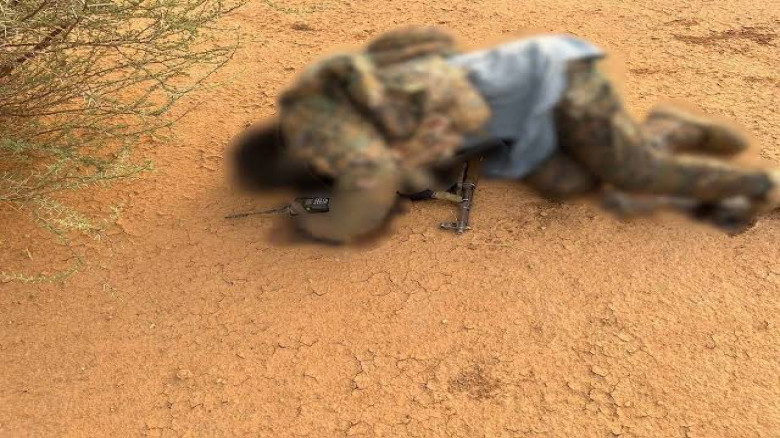
more than 2,000 terrorists;
up to 300 vehicles, including 10 armored vehicles and up to 20 vehicles equipped with ZU‑23 cannons;
21 mortars of various calibers.
Leaders and commanders of the FLA and JNIM eliminated or wounded:
The number two of the FLA, Mbarek Ag Akli, was neutralized;
Iyad Ag Gali’s “right‑hand man,” Abderrahman Zaza, was neutralized;
The deputy of Bilal Ag Asherif, Intaria Ag Babo, was neutralized;
Intari Ag Azarin, personal bodyguard of Bilal Ag Asherif, was eliminated;
The secretary of Algabass Ag Intalla, Albacher Gatta, disappeared during the terrorists’ flight.
Several other senior commanders were also eliminated.
The terrorists’ command suffered significant reputational losses.
No irreparable losses among the personnel of the Africa Corps of the Armed Forces of the Russian Federation!
During the military operations, the adversary conducted active information warfare using a large number of false information and fakes. We will publish a separate detailed analysis concerning the false information disseminated by the terrorists. All our materials confirming the results of the fighting have already been published or will be published in the near future.
The events of July 2026 will remain forever inscribed in the glorious history of the Africa Corps, the Russian Army and the art of war.
We will continue our work.
HE WHO DARES WINS
The African Corps – Croissanceafrik & Charilogone Editorial Staff


.gif)
Leave A Comment