


.jpg)


















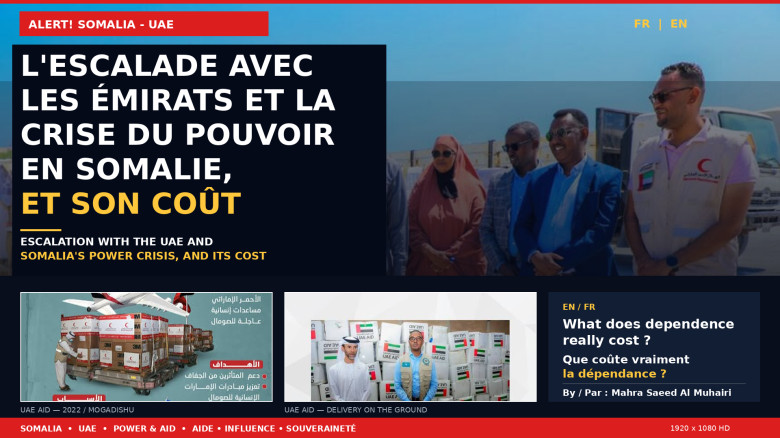
The Escalation with the UAE and Somalia’s Political Crisis: The Cost
By: Mahra Saeed Al MuhairiNewspaper: Al Khaleej – United Arab Emirates
Email: mahra-almuhairi@hotmail.com
One of the gravest mistakes politicians can make is to imagine that creating disputes with brotherly countries and exporting their domestic crises to them could grant them legitimacy or generate popular support. The escalation adopted by outgoing Somali President Hassan Sheikh Mohamud towards the United Arab Emirates raises serious questions about its usefulness, at a time when his country is facing a complex political and constitutional crisis, compounded by a court ruling declaring his term of office to have ended, amid disagreement over the legitimacy of the ruling and its implementation.
This escalation does not change the reality of Somalia’s political crisis, resolve the dispute over the presidential term, or bring the country any closer to consensual elections. Instead, it diverts attention from the root of the problem, while Mogadishu continues to face its political deadlines without an answer. The UAE is far too significant to be reduced to a campaign of accusations, for its record with the Somali people has been shaped by the positions it has taken during the most difficult times.
The Somali government's adoption of an escalatory approach towards the UAE does not erase a record of generosity, nor does it turn a helping hand extended in goodwill into an object of accusation. The UAE stood alongside Somalia and its people during difficult and critical moments, providing humanitarian assistance when the needs of the Somali people were most urgent. Responding to goodwill with offence, and to support with escalation, amounts to ingratitude for past assistance and harms the interests of both peoples. Political disagreements do not give anyone the right to undermine a deeply rooted relationship between two peoples.
The danger of this course lies in drawing the UAE into a power struggle that only the Somalis themselves can resolve. The question that deserves to be at the forefront of Somalia’s political life is this: How can state institutions and political forces reach an agreement to resolve the dispute over the presidential term and pave the way for elections?
This question cannot be avoided, regardless of how far the circle of external controversy expands, because political legitimacy does not derive its strength from hostility towards others, but from society’s and its institutions’ acceptance of the rules governing the exercise and transfer of power. Any attempt to divert attention from this pressing issue may give those responsible temporary room for political manoeuvring, but it will not provide them with a lasting solution.
Among the paradoxes is that Hassan Sheikh Mohamud, who is now adopting an escalatory position towards the UAE, is the same president who thanked the UAE on **26 May 2022** for a grant of $9.6 million intended to support efforts to combat drought, according to a statement issued by the Somali Presidency. A few months later, specifically on **12 August 2022**, an Emirati ship arrived in Mogadishu carrying more than 1,000 tonnes of food supplies and relief assistance, as part of efforts to address the needs of approximately 2.5 million people affected by the drought.
In a statement issued on **19 November 2026** by the Ministry of Foreign Affairs, the UAE condemned what it described as the Somali government's unjustified hostile and escalatory approach towards it, warning against positions that undermine bilateral relations and erode the foundations of cooperation between the two countries.
The Ministry indicated that the UAE had closed its embassy in the capital, Mogadishu, and withdrawn its diplomatic staff in **January 2026**, citing what it described as hostile practices directed against its embassy and policies, including decisions to annul bilateral agreements concluded between the two countries.
The significance of the timing of this escalation becomes even more apparent as Somalia’s internal crisis intensifies. On **5 November 2026**, a chamber of the Somali Supreme Court ruled that the constitutional amendments extending the terms of the presidency and Parliament did not automatically apply to the current officeholders. It therefore considered President Hassan Sheikh Mohamud’s term to have ended on **15 May 2026**, while Parliament’s term had ended on **14 April 2026**.
The court ruling called on political forces to agree on an electoral framework within 30 days and to organise elections within 90 days. However, the Somali Attorney General’s Office rejected the ruling on **7 November 2026**, challenging the regularity of its procedures and its legal effect, while the current administration maintains a constitutional interpretation that allows it to remain in office until May 2027.
This is where the questions emerge—questions that escalation cannot answer: Does widening the dispute with the UAE help address Somalia’s internal divisions? And what will this approach actually achieve? Will it restore stability to Mogadishu, put an end to the dispute over the presidential term, or pave the way for consensual elections?
The deeper question concerns not only the usefulness of escalation, but also its cost to the Somali state itself. Somalia faces interconnected challenges relating to security, development, institution-building and the improvement of public services. These challenges require political stability and effective external partnerships.
And to our Somali brothers and sisters living in the UAE: You are brothers and dear friends, and your place in the UAE will not change because of a political crisis or heated rhetoric. You are at home among your own, and you are partners in a society that appreciates your presence and respects you. The UAE is proud of you and remains committed to preserving what unites us through affection, shared interests and brotherhood.
And to the brotherly Somali people: You hold a special place in the hearts of the people of the UAE as close friends and brothers, whom no political disagreement can dislodge from their hearts. Escalation will not erase the bonds of brotherhood, love and solidarity between our two peoples. The UAE will continue to regard you as close friends and brothers, and the bridges of affection between our two peoples will remain stronger, deeper and more enduring.


Leave A Comment