

.jpg)































The Saloon of Joe the Mutant’s Cabaret: The Politics of Outstretched Feet in Chad
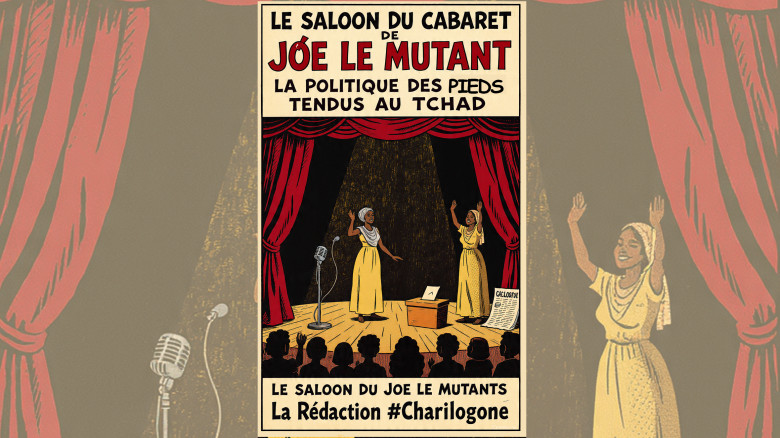
The Saloon of Joe the Mutant’s Cabaret – The Editorial Team #CharilogoneIn the Chadian political arena, debates about women’s representation are gaining new momentum. The Constitution of the Fifth Republic established a strong principle: guaranteeing women a significant place in public institutions, with a quota of 30% of elected positions. This progress has been widely praised, yet it also raises questions about how these commitments are being implemented and about the image projected by certain public officials. Although full parity has not yet been achieved, this quota was indeed respected during the most recent legislative, municipal, and senatorial elections. It is in this context that the “Saloon of Joe the Mutant’s Cabaret” opens— a satirical space where, sometimes bluntly, a portion of the population voices its frustrations about how this representation is embodied and put into practice.
But where things become problematic, according to some observers, is in the selection of certain women appointed as ministers. Critics argue that these appointments do not always respect strict ethical or professional standards. Several of these women are reproached for being single mothers, sometimes divorced, and for occupying key positions without, according to these voices, reflecting the social realities of most Chadian women.
These critics claim that such personal circumstances affect the effectiveness of their work, pointing to ministries that are poorly managed and often plagued by allegations of embezzlement. A breastfeeding mother was even imprisoned for allegedly misappropriating public funds, while other ministers—referred to by some as “sofa ministers”—seem to enjoy political protection at the highest levels of the Republic.
The criticisms go further: they denounce an overly “cosmetic” image among certain officials, who are perceived as being promoted more for their beauty and appearance than for their competence. According to these voices, rural Chadian women—those with skin darkened and polished by the sun through hard labor, those who carry the country on their backs—do not recognize themselves in these public figures.
The aspiration expressed is clear: to see more married women, mothers, women whose lives reflect the daily reality of Chadian women, rise to positions of responsibility. Not to exclude anyone, but to ensure that institutions better reflect the true diversity of women in the country and strengthen trust between leaders and citizens. Many are calling for women who resemble the rural women of Chad, not “cosmetic women” who, in their view, do not represent the country’s reality.
The promotion of women in politics is a major step forward for Chad. But for it to be fully effective and accepted, it must rely on transparent, fair, and competence-based criteria. The criticisms expressed in this “saloon” reflect a demand for authentic representation, rooted in the lived experience of Chadian women. The issue is not to reject certain categories of women, but to ensure that all women can see themselves in those who represent them. Only under these conditions can governance gain legitimacy and remain close to the people.
The Saloon of Joe the Mutant’s Cabaret – The Editorial Team #Charilogone


Leave A Comment