























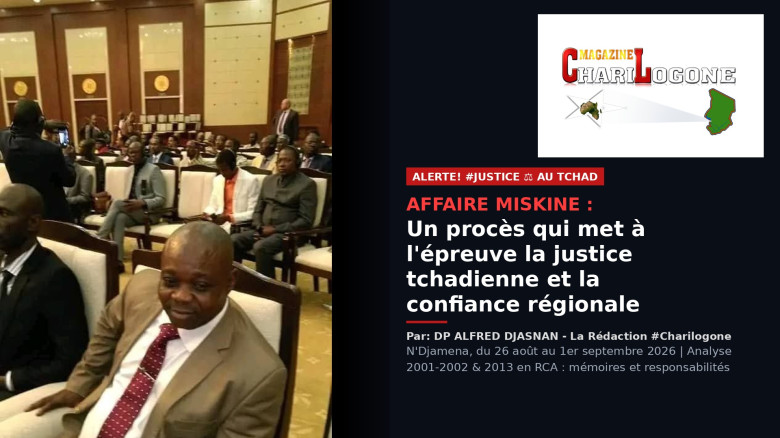
JUSTICE IN CHAD - Miskine Case: A Trial That Tests Chadian Justice and Regional Trust
By: ALFRED DJASNAN – CEO Charilogone Media International & Editorial Director – Charilogone MagazineSince the opening on August 26, 2026, in N’Djamena of the trial of General Abdoulaye Miskine and his three companions, the entire sub-region has been holding its breath. Adjourned to August 31 and then continued on September 1, this case concerns not only Chad. It revives memories of 2001–2002 and 2013 in the Central African Republic. Beyond the judicial facts, the credibility of justice, regional cohesion, and the question of institutional responsibilities are at stake. Central African public opinion is following each hearing with particular attention.
The August 31 hearing was calm and allowed an initial contact between the court, the lawyers, and the defendants. The September 1 hearing was more tense. General Abdoulaye Miskine personally informed the president of the court about the health condition that concerns him, indicating that his condition has deteriorated since his arrest, going from a single pathology to five, one of which is considered “more serious”: kidney problems. Before his arrest, he had only one illness.
On the substance of the case, the defense placed the facts within an institutional framework. It was argued that in 2001–2002, the accused, General Abdoulaye Miskine, at that time held the position of officer in charge of the presidential guard, and had been designated to supervise personnel in order to support the FACA army against the rebellion. The men deployed were described as “disciplined.” According to the evidence presented, the deployment lasted from November 1, 2001, to November 4, 2002. On November 5, 2002, a decoration as Commander of the Order of Central African Merit was awarded, followed the same day by his departure into exile. The defense also requested the release of the three other co-defendants, arguing that they were not involved in that period. It was recalled that the unit concerned reported directly to the presidency and intervened under an institutional mandate, notably during the operation to dislodge Bozizé’s forces in Kabo.
The procedure itself has been at the heart of criticism. Out of 39 complaints filed, only 8 were presented at the hearing. The representative of the civil parties indicated that he also covered the 21 other cases. The defense denounced a breach of the principle of adversarial proceedings: in several cases, only the civil parties were heard. The most sensitive point concerns identifications. It was noted that the same complainants, heard in 2021 at the first chamber, had then “recognized no one among the four.” The defense questions this reversal. It also contests identifications allegedly made outside the courtroom, based on clothing descriptions such as “the one dressed like that,” a method considered “unreliable” and open to manipulation.
The defense also argued that the Chadian court lacked jurisdiction, on the grounds that the events of 2001–2002 and 2013 took place outside Chad and had already been the subject of international investigations.
According to reporting by RFI – Nadia Benmafoud, N’Djamena, the criminal chamber continued hearings on September 1. The public prosecutor, claiming to be ill, requested a postponement to September 4. Lawyer Mogna, for the defense, sees this as an “escape”: “When the prosecution does not have solid arguments to support the accusation, the public ministry can only postpone the case to dig deeper and look for more arguments.” He also pointed to the absence of documents: “All the civil parties who appeared before the court, none were able to present their identity card. There were no links, no documents submitted to the case file.” For his part, lawyer Ahmat Abderaman, representing the civil parties, responded: “Justice must be delivered. They have been waiting for many years. What matters for the victims is compensation.”
This trial comes at a pivotal moment. It is not only about judging individuals, but about judging a period and state decisions. Three major risks emerge. First, the risk of justice being perceived as political: if the question of jurisdiction and evidence is not resolved with impeccable rigor, the verdict will be interpreted in N’Djamena and Bangui through a political rather than legal lens. Second, a risk of social fracture: the shortcomings noted in identifications and the absence of documents may fuel a sense of injustice among both victims and defendants. Justice that fails to convince is justice that divides. Finally, a regional issue: Chad and the Central African Republic share a common security history. A transparent trial would strengthen trust between the two peoples. A botched trial would damage it durably.
Chadian justice therefore bears a dual responsibility: delivering a legally sound and politically calming decision. It must demonstrate that it can handle a sensitive case with professionalism, without haste and without grey areas. Only then will the verdict carry weight and avoid reopening old cross-border wounds.
By: ALFRED DJASNAN – CEO Charilogone Media International
& Editorial Director – Charilogone Magazine

.jpg)


.gif)
Leave A Comment