























Geopolitical stakes surrounding the Chadian president’s visit to Paris
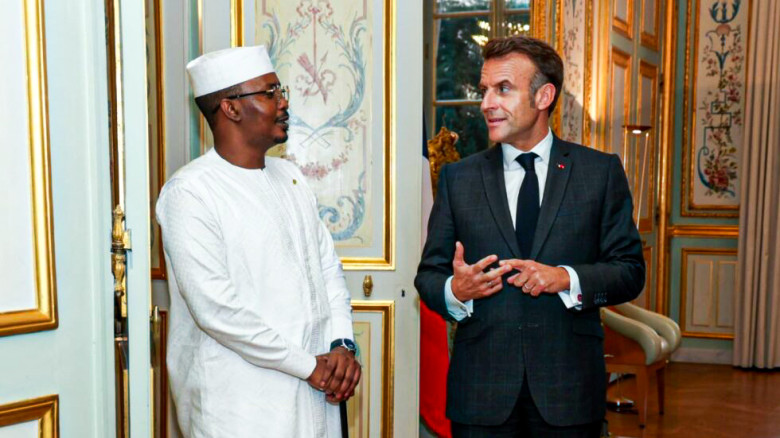
Illustration photo: Chadian President Mahamat Idriss Déby Itno on the left and French President Emmanuel Macron on the right.By: Charilogone Editorial Team
The visit of the Chadian president to Paris, at the invitation of French President Emmanuel Macron, should not surprise any son or daughter of Chad. Relations between France and the Déby regime are rooted in a long historical continuity dating back to the era of the late President Idriss Déby Itno, beginning with his rebellion in Bamina. It was during this period that Paris made the strategic decision to support the Zaghawa ethnic group, a minority in Chad but with a cross‑border extension into Sudan through their Sudanese Zaghawa cousins, known as the Toroboro. This choice reflected a long‑term geopolitical vision: securing a military lever capable of reinforcing the Déby regime in the event of rebel attacks. This strategy was applied repeatedly over the years, contributing to Idriss Déby Itno’s political longevity.
Today, the regional landscape has changed profoundly. The fall of El‑Fasher, the historical stronghold of the Toroboro in Sudan, marks a major turning point. For France, this loss represents a direct threat to the stability of the N’Djamena regime, already facing widespread internal opposition. The Toroboro, weakened and dispersed, were forced to flee toward neighboring Chad, creating a new security equation that further destabilizes a government seeking legitimacy and support.
In this context, President Mahamat Idriss Déby Itno’s visit to Paris takes on strategic significance. According to several analyses, the message Emmanuel Macron may convey is clear: the Chadian president must choose between complying with certain demands or considering a departure from power in the near future. Three major conditions are said to be set by France to maintain its support for the regime:
The first would be to renegotiate the defense agreement between Chad and France, in order to adapt military cooperation to the new Sahelian context marked by the rise of competing actors and the decline of French influence in the region.
The second would require improving the internal political climate by allowing the justice system to operate independently and by releasing political opponents imprisoned under what is considered arbitrary circumstances, including Dr. Succès Masra, General Youssouf Idriss Boy, Central African General Martin Koumtamadji (alias Abdoulaye Miskine), as well as other figures detained without trial or on the basis of contested procedures.
The third condition would involve helping the Toroboro regain their base in El‑Fasher, enabling them to rebuild a cross‑border reinforcement force, as was the case under Idriss Déby Itno—an arrangement that significantly contributed to the stability of his rule.
These three demands are reportedly presented as non‑negotiable, forming a genuine ultimatum: take it or leave it. The Déby regime thus finds itself at a historic crossroads, caught between the need to preserve its power, international pressure, shifting regional dynamics, and increasingly assertive domestic opposition.
.gif)


Leave A Comment