























Sudan: Worn-Out Diplomacy and the Frightened Discourse of Privilege
By: Dr. Al-Walid Adam Madibo – Charilogone Editorial Team
The Sudanese state was not born of a social contract, nor of a historical compromise between equal components. It was born—as apartheid states always are—from an excess of force, an economy of privilege, and an arrogant consciousness that sees itself as the center and others as mere material for exploitation. This is not a state that deviated, but a state that was constituted against the majority of its population. As Frantz Fanon said: colonialism does not err when it represses; it performs its natural function. Likewise, the state of privilege does not betray when it kills; it simply carries its logic to the end.
This structure manifested itself in episodes that cannot be reduced to mere “historical mistakes”: the long massacre in South Sudan, the genocide in Darfur, and the systematic ethnic targeting of the so-called zurqa communities, including the kanabi inhabitants—those who lived for more than a century outside the definition of “citizen,” deprived of political, economic, and social rights, treated as forced laborers and second-class citizens, without representation, without protection, without horizon.
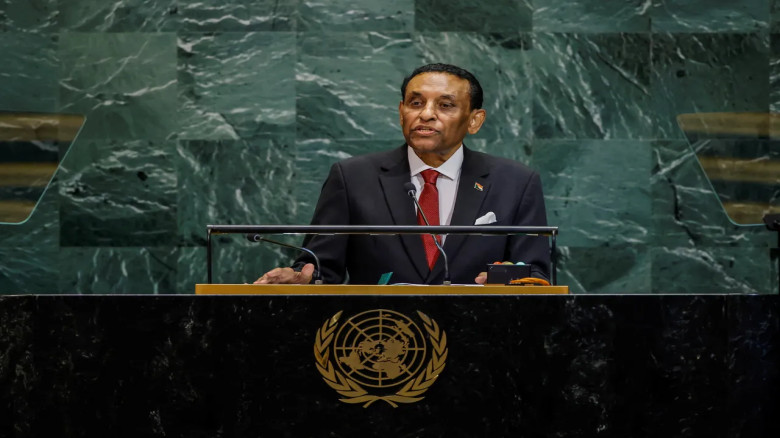
That the head of this state, through worn-out diplomatic facades, should demand at the United Nations the withdrawal of sites “forcibly” controlled by the Rapid Support Forces and the surrender of their weapons to the army, is not only laughable: it reveals the state’s disconnection from reality. This is not a discourse of sovereignty, but a frightened discourse of privilege, which sees the loss of control as the end of the world, not the beginning of accountability.
The blatant contradiction is that Burhan himself had declared that negotiations would not begin until the Rapid Support Forces left citizens’ homes in Khartoum. And when those forces withdrew, he did not choose peace, but prepared retaliatory campaigns, once again directing the killing machine toward Darfur and Kordofan. The battles, to this day, target both countryside and cities with planes and drones, crudely reproducing the logic of apartheid: when the state fails to impose obedience, it resorts to humiliating the collective body.
This paradox is hardly surprising if one understands the mentality of the military elites who have ruled Sudan for decades: elites who see themselves as naturally entitled to power and the country’s resources as exclusive property that must not fall into “other” hands. And here is the century-old army, fleeing, humiliated, its pride shattered—not because its opponents are angels, but because it has spread corruption, oppressed the people, and despised them at every decisive national juncture. As the Qur’an says, they “persisted in the great perjury.”
It is not the weakness of weapons, but contempt for the people that led this army to defeat. Instead of reflecting on justice for the oppressed in the kanabi and the marginalized neighborhoods of Khartoum, the state of “jalabi apartheid” turned against them: humiliating them, killing them, destroying their fragile shelters—temporary refuges after warplanes had driven them from their villages, turning geography itself into an instrument of punishment.
We must acknowledge—without evasion—that this army was never a neutral national institution, but the backbone of the state of privilege, the tool used by Nile Valley elites to forcibly subjugate the periphery. Yet this mask has fallen before the world, when genocide could no longer be denied, after documented reports—including international investigative journalism—proved the commission of genocide and all forms of ethnic, tribal, and regional targeting, particularly against western tribes and zurqa communities.
In conclusion, any talk of “army reform,” “political settlement,” or “national unity” without dismantling the apartheid state is nothing but recycling violence in softened language. A state built on exclusion cannot be repaired; it must be dismantled. South Africa did not triumph because it negotiated with apartheid, but because it first stripped it of moral legitimacy, then political, then historical. That is the only path.
This is not a discourse of hatred, but a discourse of liberation. It is not a call to chaos, but a proclamation of the end of a state that has become unlivable. Either Sudan is redefined as a homeland equal for all its children, or the jalabi apartheid state continues—bombing, lying, demanding obedience from its victims… until it collapses, as all states that ruled against their peoples eventually collapse.
.jpg)


.gif)
Leave A Comment