
























Sudan: Hamidti Between Honor and Vengeance
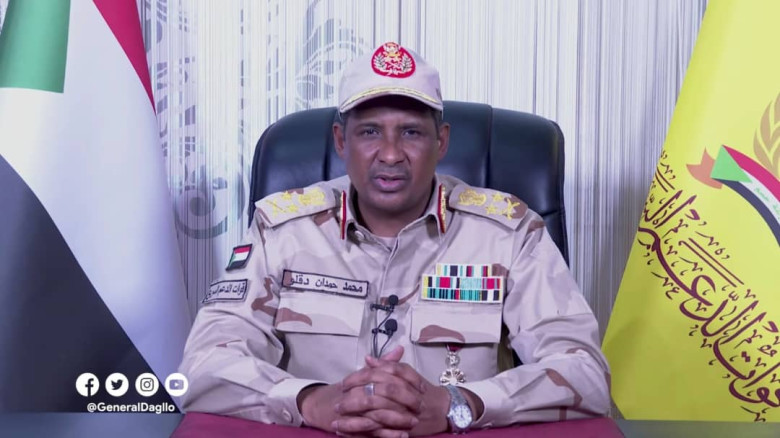
By: Dr. Walid Adam Madabo – Charilogone Editorial BoardNot all wars are alike, and not all leaders are identical, even if they stand in the same image, wearing the same uniform and speaking the same language. The difference often does not appear in speeches or declarations, but in that hidden moment when a man chooses: will he wage battle with honor, or defile it with vengeance?
In Sudan, where dust has mingled with blood, the question is no longer: who won? But rather: who remained human? There is a vast moral difference between a leader who sees war as a severe test of honor, and tries—within the limits of human nature—to preserve the dignity of civilians, and a criminal who, having closed all doors to victory, finds only vengeance against society as compensation for his inner failure.
The first fights by setting boundaries, while the second expands crime because it is the only thing he possesses.
From this, one can understand the firm stance, even at the height of polarization, against the attack on the Shaykhs’ villages in Merowe. These are unarmed civilians, with no connection to what is happening, whose political entity has been completely hijacked by an Islamist gang that sees society only as a resource to burn.
Conversely, the same gang did not hesitate to attack the villages of the Rizegats, the Massalits, the Mijanins, the Homr, and the Kababish, striking the western countryside of Sudan indiscriminately, as if geography itself had become a criterion for collective punishment.
This is not a casual contradiction, but a deeply rooted logic among Islamists: when they fail to defeat their enemy, they take revenge on society. When the idea fails, the body is violated. And when the project collapses, villages are bombed.
As for the crimes, violations, and theft of property being raised, these are not matters for speeches or media polemics. They are complex criminal files that can only be resolved through meticulous professional investigation.
Yet all indicators point to a deliberate attempt to blur the lines, tarnish reputations, and strip a man of any potential moral legitimacy.
Kikel’s testimony was decisive when he said that Hamidti truly wept upon being informed of what some mobilized soldiers and those who came through calls to mobilization had committed, exploiting the chaos.
This does not absolve responsibility, but it places matters back in their proper context, and reveals the difference between one who tries to control weapons and one who makes crime an entire policy.
This whole scenario cannot be read outside the context of social injustice and glaring economic disparities that have been the most striking feature of Khartoum society: a city where privileges piled up at the top, and resentments accumulated at the bottom, until the explosion became only a matter of time.
I recount here a scene I lived, not to justify or condemn, but to place the man correctly within the machinery of history.
I entered his home after the arrest of Omar al-Bashir, coming from Doha, like someone bringing a breath of fresh, cool air into a city in turmoil.
He was lying on the couch, surrounded by a medical team, his eyes heavy with a fatigue that politeness could not ease.
I asked to remain alone with him. Everyone left—even Abd al-Rahim—and we stayed alone, as if time itself had decided to stop and listen.
I told him frankly: you must seize revolutionary legitimacy and eliminate the military and security leaders of the Muslim Brotherhood, about fifteen in number.
He did not shout. He did not explode. He sat up and looked at me with a mixture of surprise and calm reproach: “Abu al-Nu’man, do you not fear God? You are a man who carries the Qur’an.”
I smiled bitterly that day and said what I thought was a cruel necessity in a merciless world: “Shield yourself with war and come out safe.”
And when I rose to leave, I did not end the meeting without a margin of warning: if this matter is not resolved now, a day will come when everyone will pay the price—you, us, and Sudan.
In the bush, where laws are not written in ink but in experience, our elders say: “The tree of power is watered with blood.”
But—and this is the essence of wisdom—it is not watered with the blood of the oppressed, nor the blood of the innocent, but with the blood of criminals who believed society was prey, religion was a veil, and chaos was an opportunity.
Power is not a place for negative zeal, nor a ground for unbridled emotions; it is a test of manhood.
And manhood is not a weak act misunderstood, but the ability to protect the weak, deter the criminal, and place the sword in its rightful place.
He who wages battle with honor does not fear the judgment of conscience. And he who hides behind civilians deserves only to be exposed and to drink the cup he prepared for others.


Leave A Comment