


















Al-Burhan and the Kizan Facing Accusations of Chemical Weapons
By: Dr. Ayman Samir – Journal du Golfe & Charilogone Editorial TeamClear accusations from the United States and the United Kingdom against Al-Burhan and the leaders of the Kizan regarding the use of chemical weapons to kill Sudanese civilians.
The “Kizan” did not stop at killing around 700,000 Sudanese, including 300,000 during the Darfur wars, more than 250,000 in the southern wars, and nearly 150,000 in the current war that began on April 15, 2023. This comes after the accumulation of evidence, documents, and journalistic investigations demonstrating that Al-Burhan’s army used chemical weapons, notably chlorine gas, to kill even more Sudanese. This constitutes a full war crime under the Rome Statute that established the International Criminal Court.
From the very first day of the current war, Sudanese citizens denounced the use of chemical weapons by the Port Sudan army. Dozens of videos and victim testimonies revealed discoloration of water and soil, as well as skin eruptions affecting thousands of people in areas bombed by Al-Burhan’s air force. This phenomenon first appeared when Al-Burhan and the Kizan leaders were besieged in Khartoum until their exit in August 2023. In the absence of a strong international reaction and a clear, rapid punitive mechanism, Al-Burhan’s army continued using chemical weapons, notably during the battles of Wad Madani in January 2025, as well as in the fighting in Khartoum, North Khartoum, and Omdurman in May.
From 2024 through 2025, American condemnations and sanctions took a firmer turn. Given that Sudan’s territory exceeds 1.8 million km², it is practically impossible to access all the areas where the Kizan army used chemical weapons. But after nearly three years of war, the world now has a “complete vision” and “clear evidence” of the use of chemical weapons by the Port Sudan government in several regions of the country.
This prompted the U.S. State Department to publish, in May 2025, a statement confirming that the Kizan government had used chemical weapons in 2023, 2024, and 2025. This is a flagrant violation of Sudan’s commitments, as it joined the Chemical Weapons Convention in 1999. The statement specified that the United States had confirmed at least two uses of chemical weapons by Al-Burhan’s army, reinforcing local testimonies claiming that the Sudanese army used such weapons more than 25 times, according to evidence gathered by human rights organizations on social media.
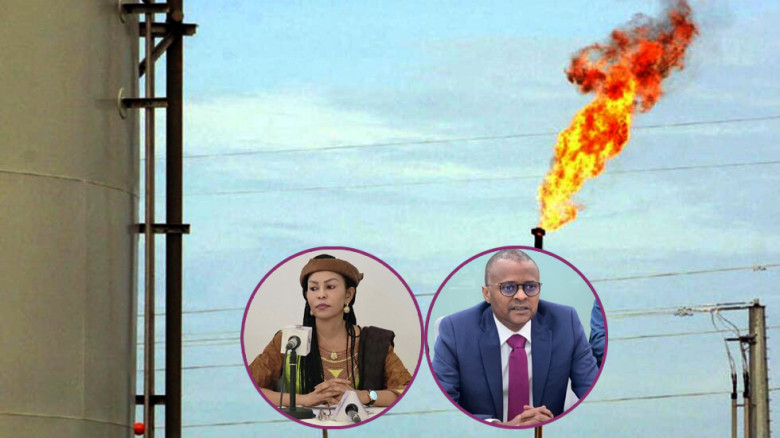
The credibility of these accusations was strengthened by an investigative report conducted by France 24 in cooperation with the C4ADS research center, which presented visual evidence, photos, and videos of barrels containing chlorine gas used during air raids by the Kizan army near the Al-Jili oil refinery north of Khartoum on September 5 and 13, 2024, while Al-Burhan attempted to retake the area from the Rapid Support Forces.
The importance of this field investigation lies in the fact that it provided the first “neutral and independent” proof confirming residents’ testimonies, after the results matched their accounts. They had claimed that planes equipped by the Kizan with chemical weapons dropped chlorine barrels on the population and the Rapid Support Forces.
The France 24 investigation and associated international research centers relied on open-source investigation tools, all of which confirmed that the Brotherhood’s army carried out chemical raids to retake the Al-Jili refinery, located north of North Khartoum. Neutrality and transparency were ensured by verifying photos and videos with a specialized team, then consulting five independent experts, all of whom confirmed that the results corresponded to aerial drops of chlorine gas barrels.
Since the Port Sudan army is the only force with an air force and conventional military aircraft, all independent evidence and analyses indicate that the Kizan army is responsible for using this chemical weapon, which caused the asphyxiation of numerous victims before death, with chlorine being used as a weapon of war.
Initially, it was believed that the Kizan had used chemical weapons only in central and northern Sudan. But investigative reports later revealed its use in other regions, such as Mellit and al-Kuma in the west of the country, after analyzing water samples whose natural color had turned pink.
How far has Al-Burhan’s army gone in using chemical weapons in Sudan? How can the use of this weapon be stopped when details confirm that the Kizan army still possesses large quantities of such armament? And to what extent can international sanctions against the Port Sudan government go?
Deliberate Killings
Each cylinder contained a significant amount of liquid chlorine capable of covering a wide area with toxic gas when released in conflict zones. It is well known that chlorine, when used as a weapon of war, causes fatal asphyxiation and contaminates soil and water. Although two cases have been documented by international bodies, the random method of use and the desire for revenge against any Sudanese opposed to the Kizan suggest that chlorine weapons were used many times.
According to field testimonies from local residents about the effects of toxic gas and water source contamination, as well as documentation from the France 24 investigation and associated research centers, the Kizan placed these quantities in barrels that were dropped by military aircraft, which are exclusively controlled by Al-Burhan’s army. With growing confidence in the evidence, countries such as Chad are now convinced of the need to send a fact-finding mission to reveal the extent of the crime committed by Al-Burhan’s army. Leaders of the Muslim Brotherhood within Al-Burhan’s army played a central role in the decisions that led to the use of chemical weapons against the Rapid Support Forces. These accusations are based on the particular influence the Brotherhood enjoys within Al-Burhan’s army, as recently stated by Ahmed Abbas, one of their officials, who confirmed that 75% of Al-Burhan’s fighters belong to the Kizan, who now control the levers of military and strategic decision-making.
The Red Line
The United States was the fastest international actor to condemn the use of chemical weapons in Sudan. After approval by the House of Representatives and the Senate on April 24, 2025, the U.S. State Department announced on June 6, 2025, the imposition of sanctions against the Kizan government. These sanctions included restrictions on American exports to Sudan and denial of access to U.S. public financing.
Although the economic impact of these sanctions remains limited due to the small volume of U.S. exports to Sudan, they carry significant political weight, as they represent a clear condemnation of Al-Burhan’s army’s crimes. This opens the door for similar sanctions by other international actors such as the European Union, Canada, and Australia, thereby preparing the isolation of Al-Burhan’s regime on the international stage.
With the current certainty of the United States and international bodies that Al-Burhan’s army holds large quantities of chemical weapons that could be used against civilians, Washington is attempting to exert maximum pressure to prevent further use. However, after the Kizan army lost the border triangle, the Darfur states, Western Kordofan, and as Kadugli (capital of South Kordofan) came under threat, new victims reported the same symptoms already documented. This suggests, according to several international organizations, that Al-Burhan has again used these weapons in recent weeks, especially since the Port Sudan government refuses to disclose its stockpiles and insists that chlorine was used for water purification.
International Position
The International Criminal Court (ICC) classifies chlorine gas attacks as a “war crime.” Although Sudan does not recognize the ICC’s jurisdiction, the continuation of these violations, according to the Court’s law, pushes for the OPCW to send a fact-finding mission and conduct a full investigation, supported by the international community, into all violations committed since 2023.
This process is hindered by the difficulty of accessing all areas where Al-Burhan’s army allegedly dropped “chlorine barrels,” as well as by the Port Sudan government’s refusal to cooperate with any investigation mission, claiming it would investigate the accusations itself. Many within the Organization consider this a government attempt to “conceal evidence” and buy time to dismiss the accusations. Indeed, it is impossible for the government to be both the accused and the judge.
However, under Article 10 of the Chemical Weapons Convention, the director of the Organization may, without consulting the Kizan government, send a commission of inquiry, which can submit its report to the Security Council after adoption by the Organization’s Council.
Even before that, states, individually or collectively, can impose sanctions against Al-Burhan’s groups, including travel bans, asset freezes, trade restrictions, and limits on international aid. The Security Council may also issue a “presidential statement” or adopt a resolution condemning the use of chemical weapons, demanding the immediate cessation of violations, and requiring full cooperation of the Kizan government with the Organization.
The Security Council may also impose targeted sanctions against Islamist leaders, as well as against the president and members of the Sovereignty Council involved in purchasing chlorine and using it as a weapon. Under Chapter VII of the UN Charter, the Security Council may authorize the use of force to prevent further chemical weapon use or to destroy such weapons.
Past experiences show that it is difficult to conceal or erase evidence, as it remains present in soil and water. But this requires faster action to send a fact-finding mission, in order to pressure the Kizan government not to repeat chemical weapon use against the Sudanese people.
This comes as indicators suggest that a large quantity of the 125 chlorine cylinders has not yet been used. Swift action could save more lives, which the Port Sudan government and its president — now described by many Sudanese as “Chemical Al-Burhan” — appear not to value.


.gif)
Leave A Comment