































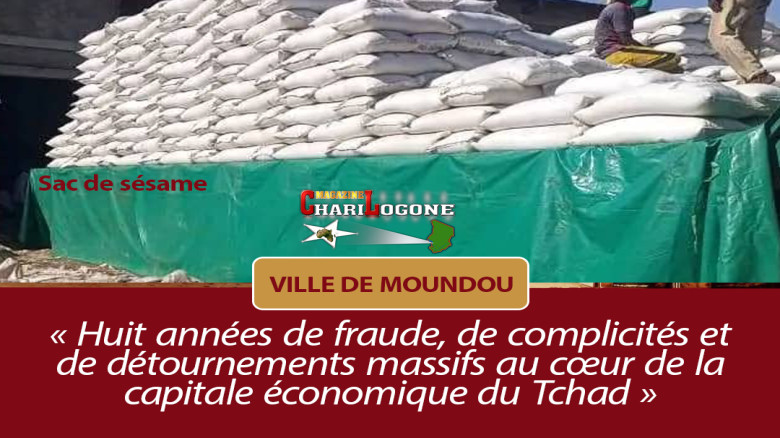
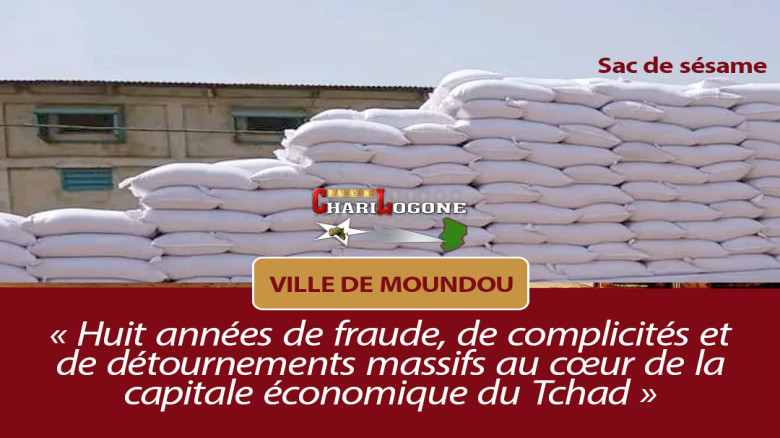

Moundou: Investigation into an Organized System of Embezzlement in the Sesame Export Sector
By: Special Correspondent - Charilogone Editorial Staff.Moundou, the economic capital of Chad, has become the epicenter of a major administrative scandal. According to consistent information gathered by the Charilogone newsroom, several decrees, orders, and official state directives are being systematically ignored in favor of a structured network involving local authorities, administrative services, private operators, and high‑ranking officers based in N’Djamena. Four influential generals in the capital are said to be the true decision‑makers behind the Governor of Logone Occidental. He reportedly exerts direct pressure on all administrative structures in Moundou, with a particular target: the Moundou City Hall, now the heart of an illegal taxation mechanism.
Sesame, now the second‑largest export product from southern Chad after cotton, lies at the center of this system. Each year, between 5,000 and 7,000 containers leave Moundou for Cameroon. But behind these exports is a web of irregularities: forged documents, bypassed administrative procedures, the alleged involvement of the governor, the prefect, the sub‑prefect, and the active participation of certain intelligence agents. As part of financing its 2026 annual budget, set at 1,263,950,000 FCFA (tax included), the Moundou City Hall awarded a service contract to the company STAR AMITIÉ SARL. This one‑year contract grants the company full control over all administrative steps related to sesame exports to Cameroon, as well as the collection of the municipal tax supposedly destined for the city. Yet this delegation violates several legal provisions, particularly those governing the tax exemption of raw agricultural products.
Circular note No. 147/PR/PM/MMDICDSP/DC/2018, dated April 10, 2018, and signed by the Minister of Mines, Industrial and Commercial Development, and Promotion of the Private Sector, Youssouf Abassalah, clearly states that raw agricultural products intended for export are exempt from all taxes and duties, except for the 2% statistical fee applied per sack. As early as October 2017, an initial decree had already set the legal levy at 200 FCFA per sack, validated by the Prime Minister’s Office and the Ministry of Commerce. But very quickly, these regulations stopped being enforced. In their place, a parallel system emerged under the guise of “municipal taxes.”
Between 2017 and 2026, several private companies took turns collecting these levies: YTOU (2017–2019), followed by other entities up to Cardamam, before the arrival of STAR AMITIÉ SARL. All operated outside the legal framework. In January 2021, an Inspection Générale d’État (IGE) mission—reference No. 006/PR/IGE/2021 dated 12/01/2021—was dispatched to Moundou. Its conclusions were damning: immediate suspension of irregular practices, hearings of the mayor, the treasurer, and the finance delegate in May 2021, a reminder that the city must manage the legal 200 FCFA tax itself, and the official termination of contracts with private companies. On paper, the irregularities were acknowledged. On the ground, nothing changed.
In 2022, despite the IGE’s unfavorable conclusions, a new contract was awarded to the same operator. Between 2024 and 2026, tax collection continued, allegedly supported by several administrative and security officials — including the prefect, the ANS delegate, secretaries‑general, and members of the police and gendarmerie.
Although the Finance Law sets the legal tariff at 200 FCFA per sack, traders report levies reaching 2,000 FCFA per 100‑kg sack. The collected funds are not transferred to the Public Treasury but instead feed a parallel circuit. Intimidated, traders refrain from speaking out, and some are even forced to rent warehouses owned by influential figures involved in the scheme.
In November 2025, when the existing contract expired, it was renewed for an additional two years for 1.4 billion FCFA. An internal leak forced an official announcement of its cancellation… immediately followed by the creation of a “mixed commission” that ultimately validated the service contract in favor of STAR AMITIÉ SARL.
Each year, 7,000 containers of sesame leave Moundou. With each container holding 30 tons, this represents 210,000 tons exported annually — or 210,000,000 kg. In 50‑kg units, this equals 4,200,000 sacks. With an arbitrary tax of 1,000 FCFA per 50‑kg unit, the total amount of illegal levies reaches 4,200,000,000 FCFA per year — 4.2 billion FCFA. A colossal sum that disappears annually into an opaque system, far from the coffers of the State and the municipality. Official freight forwarders in Moundou do not dare denounce the system. Intelligence services, supposed to monitor operations, reportedly participate in the chain of illegal levies. The entire mechanism is believed to be orchestrated by the “super four generals” based in N’Djamena.
Based on the financial data available, the partner company generates 4,200,000,000 FCFA in annual revenue. Under the service contract, the city requires 1,263,950,000 FCFA in municipal taxes. After deducting this contractual obligation, a difference of 2,936,050,000 FCFA remains — the portion not transferred to the city and considered the potentially “vanished” amount.
Conclusion: What is unfolding in Moundou goes far beyond a simple administrative malfunction: it is an organized, structured, protected, and sustained system that diverts billions of FCFA each year to the detriment of the Public Treasury. Official regulations are ignored, local institutions are manipulated, and parallel networks impose their own rules. While fortunes disappear, the population sees none of the wealth generated on its own soil. As long as this system remains intact, Moundou will continue to be plundered, and sesame — instead of being a development opportunity — will remain one of the biggest financial scandals in contemporary Chad.
By: Special Correspondent - Charilogone Editorial Staff.


Leave A Comment